https://www.infirmiere-canadienne.com/blogs/ic-contenu/2026/10/19/marcia-hills-courage-moral-faire-bienveillance
‘People think that caring is soft. But it’s very difficult,’ says Marcia Hills
By Laura Eggertson
October 19, 2026
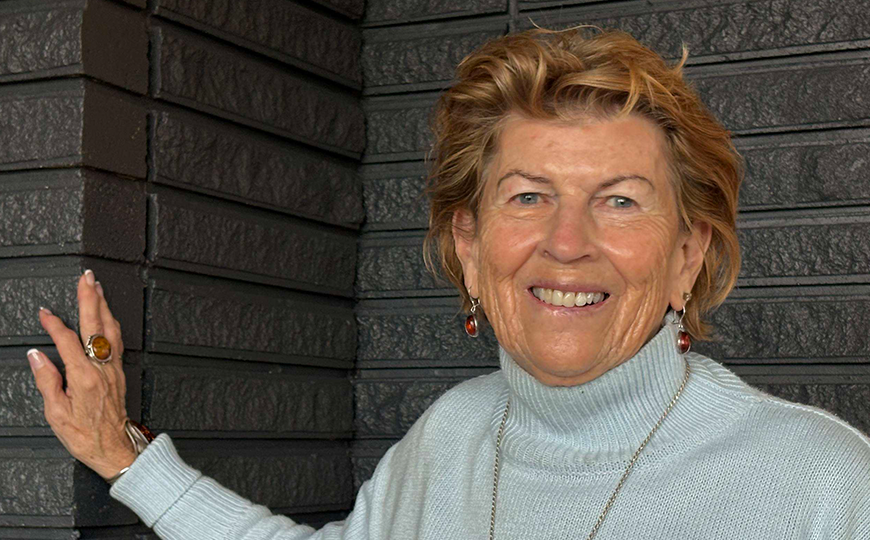 “Nursing is a caring profession. Caring is the basis, the foundation of our discipline. That sounds so straightforward, but you can’t believe how complex that is or how many people don’t actually believe that,” Marcia Hills says.
Marcia Hills is calling on nurses to lead a renaissance of caring in the Canadian health-care system.
Hills, a professor emeritus at the University of Victoria School of Nursing, has been leading efforts to create a curriculum revolution centred around caring at nursing schools in Canada since the late 1980s.
Today, as she considers the crisis in health care from the perspective of both a nurse educator and a patient, she is frustrated by the disconnect she observes.
That disconnect lies in the skills-based training and on-the-job direction nurses receive, versus the ethical, values-based caring and health promotion approach Hills believes better serves patients and the system.
“The health-care system is a mess,” Hills says bluntly. “We have patients in the hallways. We are losing our new (nursing) graduates. [Up to] 60 per cent consider leaving within the first two years.”
Humanize education
“What are we doing? How is it that nurses don’t see their leadership role in changing the situation?”
Nurses are the most abundant workers in the health-care system, Hills points out.
“What if we took on the renaissance and said, ‘This is the way the system has to look’?”
As the founding director of the BC Collaborative Nursing Program and a Fellow of the Canadian Academy of Nursing and the American Academy of Nursing, Hills has long worked to humanize nursing education, research, and policy in Canada and around the world.
Hills, who has a PhD in counselling psychology, champions caring science, a philosophical, ethical framework and foundation that U.S. nursing professor Jean Watson developed in the late 1970s.
As applied to nursing, caring science emphasizes the need for nurses to treat the whole patient: mind, body and spirit.
Caring science promotes relationships of loving kindness by nurses who work collaboratively with patients to listen to their stories and create an environment of empathy and healing, Hills explains. Caring is an action: a way of being.
Caring in action
Hills tries to imbue in other nurses the kind of care she received as a patient more than 30 years ago.
Hills was being treated for leukemia. Severely ill, she spent five days in intensive care.
She needed a Hickman line placed in her chest — a tube tunnelled under her chest wall with valves hanging out where nurses could take blood and deliver chemotherapy.
As she was wheeled into the operating room to have the line installed, Hills struggled with a severe anxiety attack. She was so agitated, her health-care team almost cancelled the procedure.
Then a nurse stopped the gurney and looked into Hills’s eyes. She put her hand on Hills.
“I’ll be here when you wake up,” the nurse said.
The gesture only took a moment, but it calmed Hills completely.
“That caring, that one moment — I’m sure she didn’t know the impact she had on me,” Hills says, tearing up as she remembers.
Nursing, and nursing education, have become largely skills-based, says Hills.
She is careful to emphasize that nursing and medicine are distinct professions, with nursing having its own specialized knowledge.
Although nurses need to know how to apply skills in their practice, they must first understand people and their unique experiences of an illness, she adds.
“That’s vastly different than focusing on a disease and how to treat it,” Hills says.
Moral imperative
For example, if a nurse listens to a patient’s experience of having a heart attack or living with diabetes or Parkinson’s disease, the patient will identify ways to help the nurse and patient develop a care plan together, she says.
Sometimes, caring also means holding ground and speaking up for your patients within the medical hierarchy.
“Caring is the moral imperative to act ethically and justly,” Hills says, quoting Em Olivia Bevis, another curriculum expert from the United States who was one of Hills’s mentors, along with Watson.
When Hills began shepherding the nursing curriculum at the University of Victoria and four other B.C. nursing schools through the BC Collaborative Nursing Program, she succeeded in bringing caring to the forefront of students’ nursing education.
“The problem is when you get onto a unit and it’s so fast-paced, everything is about the skills,” she says.
Some of Hills’s students have since told her they want to listen to their patients’ stories but feel too pressured to participate in what they feel will be long conversations.
From a nurse’s perspective, “it’s like being in a factory. But nursing isn’t supposed to be like that,” Hills says.
She teaches hands-on, practical ways nurses can demonstrate care for their patients, even in a system that overloads people.
“Time is not the real issue. We’re not adept enough at understanding the importance of a moment,” Hills says.
“Nursing is a caring profession. Caring is the basis, the foundation of our discipline. That sounds so straightforward, but you can’t believe how complex that is or how many people don’t actually believe that.”
Hills, who also founded and runs the nonprofit Global Alliance for Human Caring Education, helps nursing programs around the world develop curricula based on caring science.
Her work and that of her mentors has had broad impact; she has been buoyed, for example, by the American Nurses Association’s decision to redefine nursing as “the art and science of caring.”
The American Association of Colleges of Nursing (the equivalent of the Canadian Association of Schools of Nursing) has recently included Watson’s 10 Caritas Processes — a nursing framework that emphasizes human connection, compassion, and caring relationships — as essential in all curricula in U.S. schools of nursing, Hills says.
She also points out that the Canadian association has made no such move.
“Why not?” she asks.
The University of Victoria School of Nursing continues to incorporate caring science in its curriculum, as does the BScN Collaborative Nursing Program that Ontario Tech University and Durham College offer. That program’s philosophy reflects its “deep roots” in the caring curriculum and cites caring as “foundational to nursing practice.”
Hills is dismayed, however, by the lack of the word “caring” in the definition of nursing the International Council of Nurses adopted in 2025.
Canadian nursing organizations have not adopted the word “caring” in any of their definitions of nursing either, she contends.
“It goes to the very basic question of what is nursing — and there’s no professional agreement about this,” Hills says. “I think we need to have this debate in Canada.”
Large health-care organizations in the United States, such as Kaiser Permanente, have adopted Watson’s theory of caring science. Kaiser Permanente even employs Caritas coaches, specialized nurses and health-care leaders trained to adopt Watson’s 10 principles of caring science.
The coaches’ goals include transforming health-care delivery, bringing compassion back to bedside nursing and leadership, and promoting “authentic caring human relationships” — changes Hills would like to see in Canadians’ experiences of health care.
Drawn to teaching
She continues to encounter resistance to the idea of incorporating caring science in nursing education, though.
“People think that caring is soft,” she says. “But it’s very difficult. It takes a lot of moral courage to be caring.”
From her earliest days in nursing, even before she earned her bachelor’s degree, Hills has been drawn to teaching.
At 77, she continues to teach online courses in the foundations of caring science curriculum and pedagogy through her global non-profit organization.
The work “keeps her brain engaged,” she says, although she plans to retire at 80.
Meantime, she also enjoys spending time with her husband John, children Jenna and Benjie, four grandchildren, and a variety of women friends. She dances to all kinds of rock ’n’ roll, whips up vegetarian meals, and works out at the gym twice a week.
She hopes more nurses will embrace caring science and urges nursing schools to teach students to try to change the health-care system, not fit into it.
“It’s the individual nurse who has to change it, and if we did it together, it would work,” she says.
“Let’s have a caring renaissance.”
Laura Eggertson is a freelance journalist based in Wolfville, N.S.
#profiles
#nursing-education
#nursing-practice
#ethics
#nurse-patient-relationship
#patient-care
#leadership