https://www.infirmiere-canadienne.com/blogs/ic-contenu/2026/03/02/tonya-roy-leisha-vandermey
Tonya Roy and Leisha Vandermey brought together by passion for global health
By Laura Eggertson
March 2, 2026
 Courtesy of Tonya Roy and Leisha Vandermey
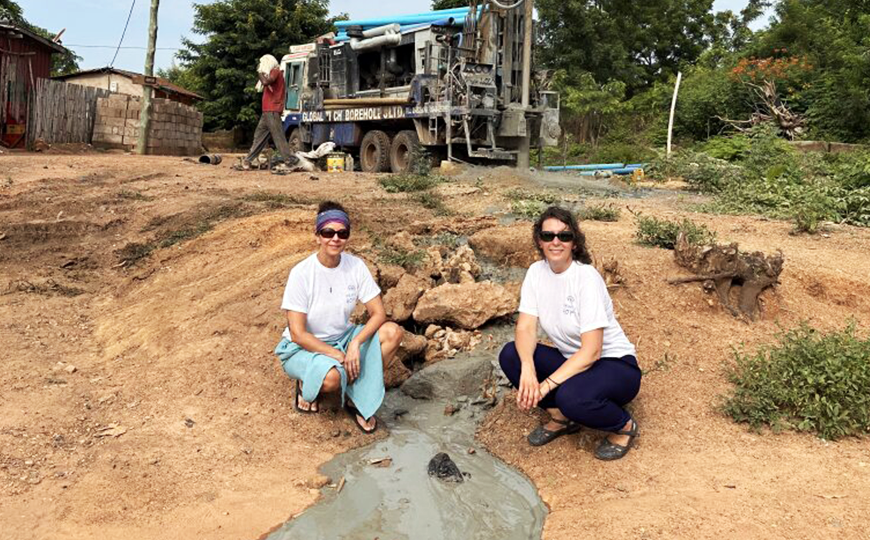
Unlike other volunteers, who may visit a location once and never return, Tonya Roy, left, and Leisha Vandermey “have been back multiple times and continue to invest in the community,” Vandermey says. Their investment in increasing the supply of clean water in the area by digging a well (above) has paid off by helping to decrease malaria levels, says Roy.
The first summer Tonya Roy and Leisha Vandermey took their nursing students to the small town of Frankadua, Ghana, a severely ill seven-year-old boy taught them all a life-changing lesson about the critical role of the social determinants of health.
 Courtesy of Tonya Roy and Leisha Vandermey
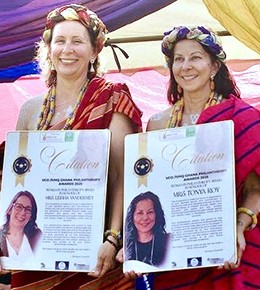
In appreciation of their work, Frankadua community members celebrated Leisha Vandermey and Tonya Roy as “queens of community improvement” and, in a ceremony, were given new names in the Ewe language: Vandermey Mama (Queen) Dumekor and Roy Mama (Queen) Dunenyo.
It was 2023. The boy’s grandmother had brought him to a clinic, where Roy, Vandermey, and about 15 of their students from Douglas College’s Nursing (bachelor of science) program were volunteering at a project that the two nursing instructors call their Ghana Field School.
The boy had an extremely high fever, was dehydrated from vomiting and diarrhea, and was hard to awaken, says Roy. He tested positive for an often deadly form of malaria.
The boy’s family could not afford the fee Ghana requires for its health insurance program, which costs the equivalent of about $1 annually and would have covered oral medication. But even if they had the insurance, it wouldn’t have covered a more expensive intravenous dose of a drug that is the first-line treatment for pediatric malaria that severe.
“The point that the kid was at, he was just too sick for oral medication,” remembers Roy.
One of Roy and Vandermey’s students, Yin Choi, asked about the cost of the intravenous treatment. The nurse in charge of the clinic told them it would cost $7 to administer the drug and rehydration therapy intravenously.
The family couldn’t afford that fee, either.
But Choi, who had a son about the same age, paid it immediately.
For the cost of a coffee
“I’m a big coffee drinker, and I go to Starbucks almost every second or third day,” Choi says. “It made me so sad — for the cost of a cup of coffee, it can save a kid’s life.”
“That was one of the most unforgettable moments I had in Ghana. That was the first time it really hit me — the reality of the poverty, and the health conditions, and the health-care system.”
The way poverty, food security, clean water, the inequities of care and other social determinants intertwine to affect individual and community health is exactly the lesson Roy and Vandermey wanted their nursing students to absorb.
Living and working in Frankadua for three weeks, as the nursing students who attend the Ghana Field School do, allows those students to realize the full impact of these factors, says Vandermey.
“It just changes these students’ perspectives,” she says. “In three weeks, they grow more than they do in three years.”
But the learning was never one‑sided. The students and faculty consistently emphasized how much they gained from the expertise, resilience, and resourcefulness of the Ghanaian clinicians who welcomed them. Many described returning home with a renewed sense of purpose, a broader worldview, and a deeper appreciation for community‑driven approaches to health.
Vandermey and Roy are close friends as well as colleagues, whose interest in global and maternal health brought them together.
Vandermey is a lab practice coordinator at Douglas College and teaches global health and pediatrics, among other courses.
Roy supervises the Douglas nursing students’ final preceptorship, and is also a forensic nurse examiner at Surrey Memorial Hospital in Surrey, B.C. She’s also pursuing her PhD in international public health.
Together, the nurses teach courses on global health. Their shared interests resulted in the Ghana Field School following their own volunteer trip in Frankadua in February 2020 — just before the COVID-19 pandemic shut the world down to travel.
 Courtesy of Tonya Roy and Leisha Vandermey
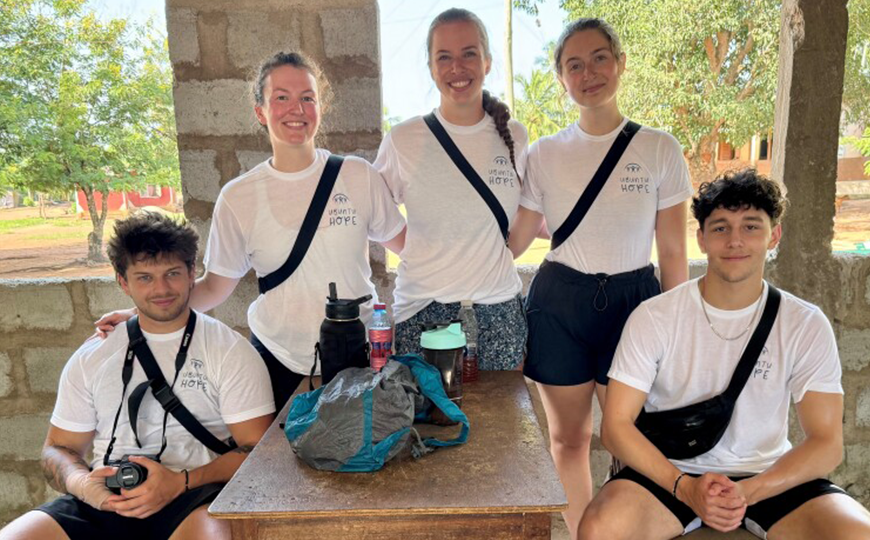
From left, Jaxson Roy, Hayley Miller, Megan Palmer, Emily Grimaldi, and Josh Vandermey have volunteered at the Ghana Field School.
Value of volunteering
Vandermey had previously owned a fair-trade company that worked with artisans in Ghana, and Roy had conducted wound care clinics in the Dominican Republic beginning in 2017.
Those experiences convinced Roy and Vandermey of the value for nursing students of volunteering in an environment where the students could work to the full scope of their abilities and realize the impact that the social determinants have on health.
In 2022, Roy and Vandermey returned to Ghana and collaborated with International Volunteer HQ, a New Zealand-based volunteer travel company, to set up the project. Since then, the nurses have developed a strong relationship with Christine Mensah, the head nurse at the health clinic in Frankadua, and with local Elders.
In 2022, Roy began Ubuntu Hope Charity, a non-profit organization that partners with the Elders to identify their priority projects for improving community health. Those projects have included drilling bore holes to ensure clean water, building a maternity wing onto the Frankadua clinic, and funding annual health insurance premiums for residents.
In the subsequent three years, nursing students who volunteer with Roy and Vandermey work with Mensah (known as Madame Christine) and the other nurse-midwives at the clinic. They help with births, triaging patients, working in the dispensary, providing immunizations, and testing for malaria, HIV, and other infections.
At the school, the nursing students play soccer, teach in classrooms, make breakfast and lunch for the children, test for malaria and treat those who are positive. They also travel by motorcycle to outlying villages three times a week for wound care and wellness checks.
“Once a month a doctor brings a portable ultrasound machine to the clinic, so the students do get to see what community ultrasounds look like,” Roy says. “They really get a lot of hands-on experience.”
Supplying clean water
Unlike other volunteers, who may visit a location once and never return, Vandermey and Roy “have been back multiple times and continue to invest in the community,” Vandermey says.
Their investment in increasing the supply of clean water in the area has paid off by helping to decrease malaria levels, says Roy — a connection that students who have returned more than once can clearly see.
Megan Palmer, now an RN who works in the operating room at Vancouver’s Lions Gate Hospital, was among the first group of Douglas students at the Ghana Field School in 2023. She has returned twice more so far.
She’s seen improvements and was drawn back by her love for the community, the warm welcome all the students receive there, and the impact on her skills, she says.
“It definitely helps round out your knowledge of health,” Palmer says of her Ghana experiences. “It helps with connecting with people.”
Although nursing school teaches the students to try to get to know their patients, immersing herself in the community in Frankadua brings that lesson home in a more holistic way, Palmer says.
“The biggest thing I took from it is not to treat the condition— treat the patient. Find out what their history is and what their resources are and work around that, so they can heal better,” she says.
For example, Palmer learned from Roy and Vandermey that many of their patients used local honey to treat their wounds, rather than topical antibiotics they did not have. She saw honey’s effectiveness first-hand in treating a leg wound from a bacterial infection in one woman, whose wound decreased by a third after prolonged use of the honey.
“I thought it was crazy at first,” Palmer says. “But there are studies that show it [honey] is beneficial, and it’s readily accessible.” She says this experience highlighted the importance of being open to understanding traditional medicine rather than dismissing it because of her western values.
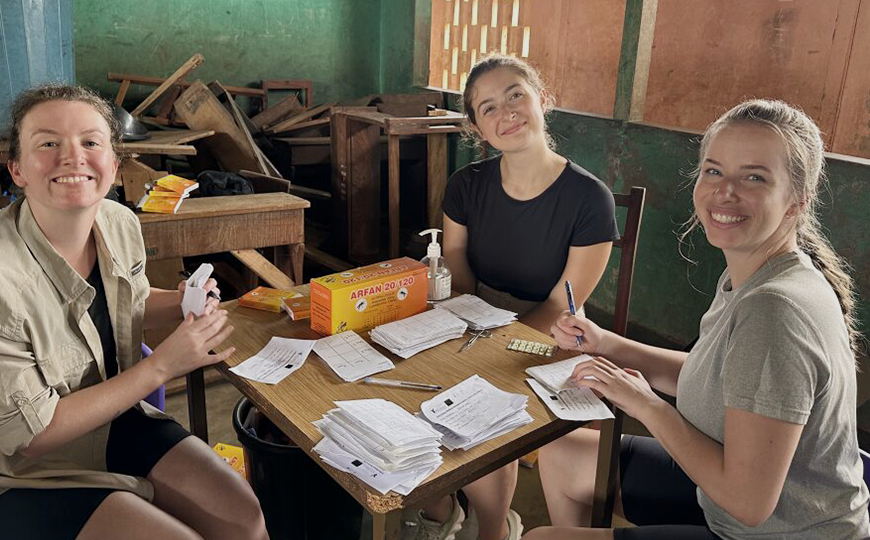
Now, Palmer and two other former Douglas College nursing students, also graduates, are hoping to return to Frankadua to lead a malaria vaccination program, in hopes of eradicating malaria from the area.
Such is the passion the Ghana Field School inspires, and Roy and Vandermey could not be prouder.
For Vandermey, a nurse practitioner who recently stepped back from her clinical practice during treatment for breast cancer, the Ghana project ensures she does not burn out.
 Courtesy of Tonya Roy and Leisha Vandermey
From left, Hayley Miller, Emily Grimaldi, and Megan Palmer are hoping to return to Frankadua to lead a malaria vaccination program, in hopes of eradicating malaria from the area.
Transforming students
“The ability to nurse in a place that is so starved of health care and basic needs makes it so easy to love people and help people and find solutions,” Vandermey says. “I love to solve problems. I love it when I teach students and see the ‘aha’ moment as their confidence grows. That gives me the passion to keep going.”
Seeing the transformation in their students, coupled with the daily joy the Ghanian community members demonstrate, fuels Roy’s passion as well.
“When we see the transformation of our students in just three weeks, there’s nothing that will top that,” Roy says.
In addition to the rewards Roy and Vandermey receive as teachers when they go to Ghana, the type of nursing they get to do at the clinic helps “fill our own buckets,” Roy says, because they can make quick treatment decisions and work more autonomously than at home.
In 2026, community members signalled their appreciation for Vandermey and Roy’s work when they made the two nurses “queens of community improvement” in Frankadua. The joyous and musical 3.5-hour ceremony involved giving them new names in the Ewe language. Elders dubbed Roy Mama (Queen) Dunenyo, and Vandermey Mama (Queen) Dumekor.
“We are only just understanding what the honour of being blessed ‘queen’ means, but that is part of what we love about what we do,” says Vandermey. “We are always learning and growing right alongside our students.”
Between trips back to Ghana, Vandermey and Roy spend time with their husbands and children, and both enjoy hiking and cycling.
Josh Vandermey, one of Leisha Vandermey’s two sons, and Roy’s son, Jaxson Roy, have come to Ghana twice to volunteer alongside them, “so we created a passion in them too,” says Vandermey.
The nurses hope to instil that passion in even more students when they create their next field school project, likely in the Dominican Republic.
They have no plans to slow down.
“If we could recreate the experiences in multiple different places, we would be so happy to do that for the rest of our lives,” says Roy.
Laura Eggertson is a freelance journalist based in Wolfville, N.S.
#profiles
#community-health
#equity-social-justice
#global-health
#social-determinants-of-health