https://www.infirmiere-canadienne.com/blogs/ic-contenu/2026/08/06/hopital-communautaire-protocole-fast
‘FAST pathway’ increased patient volume while maintaining high-quality care
By Michele Montgomery, Jennifer Watters, & Brittany Spence
August 4, 2026
 istockphoto.com/Unaihuiziphotography
Nursing professionals were instrumental in mapping the patient journey from surgical consultation through discharge.
For years, the challenges faced by Burnaby Hospital in managing hip and knee replacement patients have significantly impacted nursing practice. During the early COVID-19 pandemic, elective surgeries such as hip and knee replacements were paused, creating a significant backlog of patients. At the same time, an aging and increasingly active baby boomer population has driven rising demand for joint replacement surgery. Together, delayed procedures and increased need have placed sustained pressure on orthopedic services.
To tackle these challenges, we formed a multidisciplinary team, including an orthopedic surgeon, an anesthetist, two nurse practitioners (NPs) and a registered nurse (RN) to redesign our hip and knee replacement program.
Background
Before the creation of this team, our arthroplasty program completed occasional same-day discharge (SDD) surgeries for patients with minimally invasive hip replacements, and only two of the hospital’s seven arthroplasty surgeons had patients discharged on the day of surgery. Minimally invasive arthroplasty uses smaller incisions with less muscle and tissue disruption, resulting in reduced postoperative pain and faster recovery, making it well suited to SDD. Decisions about same-day discharge were made postoperatively, leaving staff scrambling to ensure patient education, physiotherapy, and occupational therapy assessments were completed before discharge. Patients were often unprepared for post-discharge support due to inconsistent communication.
As a team, we identified an opportunity to create an evidence-based SDD pathway for primary hip and knee arthroplasty patients across all seven surgeons. A primary joint replacement refers to the first replacement of a joint with a prosthetic implant, as opposed to a revision surgery, which is more complex. We hypothesized that this pathway would expand access to SDD, reduce inpatient bed use, and improve patient flow. NPs and RNs played a central role in developing this streamlined, patient-centred approach, known as the FAST (focused arthroplasty same-day track) pathway.
Best practice guidelines employed
We rooted our pathway in current best-practice guidelines and evidence-based literature to ensure patient safety and program success. Our literature review identified 51 relevant arthroplasty studies addressing patient selection, safety considerations, complication and readmission rates, and discharge barriers. The evidence emphasized the importance of a team-based approach and appropriate patient selection in achieving successful SDD outcomes.
These findings informed the development of an evidence-based screening tool and supported collaboration across disciplines. Nursing professionals were instrumental in mapping the patient journey from surgical consultation through discharge. The preoperative hip and knee arthroplasty clinic patient care coordinator outlined the presurgical process, including operating room booking and anesthesia consultation.
Patient screening and education were priorities
A key nursing focus was the FAST patient screening process. Clinic nurses used the screening tool to identify exclusion criteria among patients flagged by the orthopedic surgeon. Patients with exclusion criteria were not eligible for SDD, ensuring that only appropriate candidates were selected and improving postoperative outcomes.
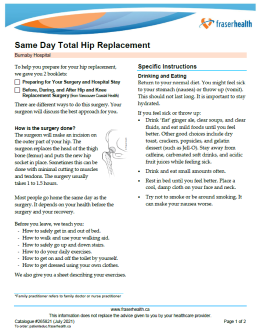
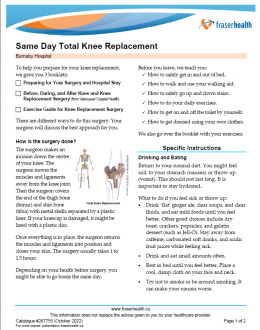 The team developed discharge education resources to enhance patient safety.
Monthly nursing huddles supported continuous communication between clinic nurses and the FAST working group. These sessions allowed staff to raise concerns, share experiences, and reinforce the critical role of nursing in program implementation.
Nurses also focused on patient education in the preoperative hip and knee clinic. As a member of the working group, the patient care coordinator collaborated with the patient education department and the clinical policy office to develop patient education handouts. These handouts (disseminated in the presurgical clinic) allowed nurses to communicate the expectations of the new pathway effectively. By equipping patients with the necessary information prior to their surgery, nurses empowered them to participate actively in their care, enhancing the overall patient experience.
Postoperatively, the clinic nurses called the patients for three consecutive days. To document these telephone calls, the care coordinator created a tool to support the nursing staff in assessing the patients post-discharge. The tool helped nurses determine each patient’s current status and reinforced the postoperative teaching, creating consistency between nursing staff during these calls.
Quality improvement program
The NP project leads, who have formal training in quality improvement (QI), spearheaded the project through the QI program design lens. They used the Institute for Healthcare Improvement’s Model for Improvement framework to drive program design, data collection and analysis, and lead improvement ideas to achieve sustainable system change. The NPs supported patient care and flow through the units, providing direct patient and staff education and feedback.
The team developed discharge education resources, including a home medication record and patient discharge algorithm, to enhance safety. FAST pathway protocols and standardized postoperative orders were also established. This QI-driven structure supported dissemination through conferences and other regional knowledge-sharing activities, as well as the development of a toolkit to help other facilities implement SDD programs.
The orthopedic surgeon and anesthesiologist program leads were essential for engaging with their department groups. They disseminated the inclusion/exclusion criteria, leveraged the group’s participation with the FAST pathway, and streamlined specific anesthetic and surgical evidence-based practices to improve the rate of successful SDD.
Engaging a patient partner was a priority. Recruited through the Fraser Health professional practice patient experience team, the patient partner provided insights that helped ensure education materials were relevant and easy to understand.
The team also identified departmental champions to support engagement and collaboration. FAST pathway huddles included operating room booking, surgical day care, and allied health teams. For example, flagging SDD patients on the operating room slate signaled allied health teams to plan same-day assessments.
Results
This pathway creation highlights the resilience of the nursing staff as they quickly learned to navigate new processes while still delivering compassionate care. The development and implementation of the FAST pathway have reinforced the pivotal role of nursing in surgical care, promoting a culture of collaboration, continuous improvement, and patient-centredness. To further demonstrate this commitment to quality improvement, the NPs created and implemented an anonymous electronic staff satisfaction survey.
- 64% strongly agreed or agreed that the pathway improved communication with the multidisciplinary team, while 23% were neutral.
- 84% strongly agreed or agreed that the FAST pathway benefited SDD patients.
- 75% also strongly agreed or agreed that the pathway facilitated timely discharges of patients compared to the previous standard of care.
Patient satisfaction was also measured. Over 50 surveyed patients reported overwhelmingly positive feedback, particularly regarding discharge materials and follow-up communication. Patients who had undergone multiple joint replacements reported more favourable experiences with the FAST pathway compared to previous surgeries. This is a testament to the excellence in direct nursing care, effective patient-centred education, and thorough follow-up phone calls to support the patient throughout their journey.
Patient quotes:
“My whole experience was excellent, clear instructions and steps throughout the journey. Everyone was thorough and fantastic.”
“This is my second knee in the past year. I had no issues after my last surgery. It went smoothly. I found the discharge materials so helpful, I kept them to review before this surgery.”
Patient safety outcomes were maintained. Postoperative emergency department visit rates for FAST patients were 4–7%, compared with a baseline rate of 7–8% based on pre-implementation NSQIP data. Thirty-day postoperative ED visits and readmissions did not increase despite higher SDD volumes, and ED visits showed a slight decrease.
As of August 2025, 36 months post-implementation, the SDD program had discharged 570 patients. This resulted in an estimated annual cost avoidance of $1,140,000, reflecting inpatient bed capacity redirected to other patient populations. The SDD success rate — defined as discharge home on the day of surgery without unplanned admission — is 84.7%.
While these results are consistent with the literature, our working group actively seeks opportunities for continued program refinement. We have greatly succeeded in our project aim of increasing the volume of SDD procedures performed from a baseline of 8% to 15% and are steadily increasing this to 33% as we include more potential patient candidates by safely expanding our inclusion criteria.
Looking ahead
The FAST program received support through a Fraser Health initiative designed to spread successful quality improvement projects across the organization. The working group partnered with other arthroplasty programs to share resources, lessons learned, and implementation support. Nursing leadership has been central to driving operational improvements, system access, and resource utilization across participating sites.
By actively engaging in the redesign of our hip and knee replacement program to include an SDD pathway, nursing professionals have maintained high-quality care and have been instrumental in shaping the future of surgical practices at our institution.
Michele Montgomery, BSN, RN, is a patient care coordinator with the Burnaby Hospital’s hip and knee arthroplasty central intake and optimization clinic.
Jennifer Watters, MN, NP, and Brittany Spence, MN, NP, both work for the Burnaby Hospital’s orthopedic surgery unit.
#practice
#care-models
#clinical-practice
#interdisciplinary-practice
#interprofessional-collaboration
#nurse-patient-relationship
#nursing-practice
#patient-care