https://www.infirmiere-canadienne.com/blogs/ic-contenu/2026/05/13/faire-oeuvre-de-memoire
Exploring the past, honouring the present, and looking to the future
 Courtesy of Studio Laporte (1975) / Graphics by Jasmine Plourde (2025)
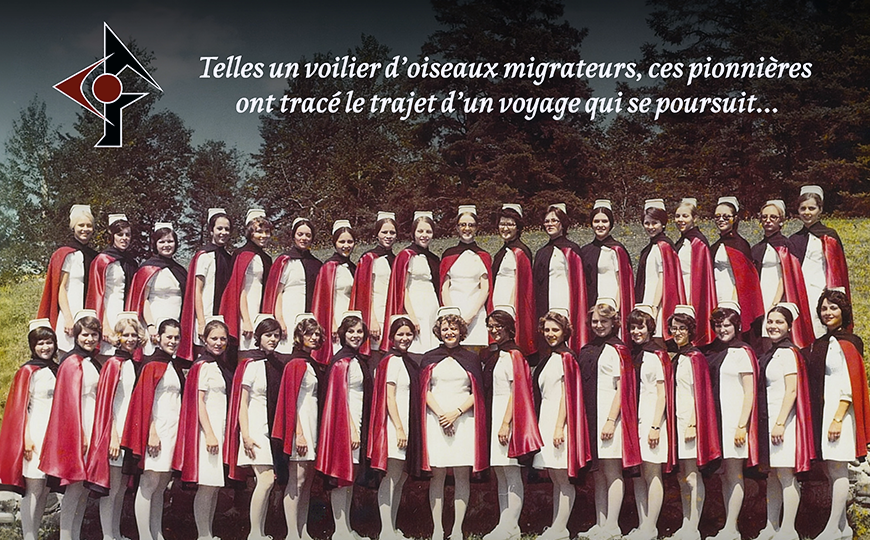
Pictured above are the nurses from the very first graduating class of l’École de formation infirmière d’Edmundston (1973-1975).
Front row: Jacinthe Dubé, Denise Thibodeau, Colombe Poitras, Lyne Tremblay, Renée Corbin, Marise Laforge, Linda Leblanc, Denise Tardif, Rachel Vienneau, Mariette Cyr, Micheline Marquis, Linda Morin, Michèle Béchard, Denise Levesque, Nicole Levesque, Louise Roy, Anne Collin, Margo Raymond.
Back row: Pierrette Cyr, Rinette Martin, Ginette Page, Michèle Marquis, Mona Long, Carole Drapeau, Marie-Thérèse Beaupré, Gisèle Cyr, Thérèse Morency, Nicole Albert, Danielle Ouellet, Claire Castonguay, Michèle Bellavance, Renée Guimond, Albina Roy, Annette Tardif, Jocelyne Lebrun, Marguerite Albert.
Absent: Monique Roy.
The French text at the top of the image appears on a commemorative plaque marking the class’s 50th anniversary. The English translation reads, “Like a fleet of migrating birds, these pioneers traced the path of a journey that continues.”
Setting the scene
It is Saturday, June 28, 2025. The nurses from the very first graduating class of l’École de formation infirmière d’Edmundston (the Edmundston School of Nursing) (1973-1975) are reconnecting with their alma mater to celebrate the 50th anniversary of their graduation.
How, in the span of a gathering that is both friendly and festive, can one pay tribute to five decades of history? The theme “commemorating through remembrance” naturally emerged as a guiding light for planning and hosting this seventh reunion since 1975. Exploring the past, honouring the present, and looking to the future: a noble endeavour that inspires both recognition and gratitude for an educational institution and the health-care professionals who have carried its torch.
Exploring the past: a historical glance
L’École de formation infirmière d’Edmundston was founded in September 1973, following a report from New Brunswick’s committee for the study of nursing education. This document marked a major turning point in nursing education in the province, recommending a learning environment within autonomous institutions, distinct from hospitals. These new settings were designed to offer students an educational framework that promoted a comprehensive understanding of health needs, going beyond the hospital context by integrating ever-evolving community perspectives. Alongside traditional curative care, new dimensions of prevention and health promotion were introduced, championed by multidisciplinary teams.
In the Northwest region of New Brunswick, the nursing profession already had a vibrant and well-established history. Before 1973, initial training was primarily provided in nursing schools affiliated with hospitals by dedicated nuns and nurses who helped create a respected profession and a strong legacy. This is evidenced by the Hôtel-Dieu, Saint-Basile, and the Hôtel-Dieu d’Edmundston, whose reputations for excellence, between 1939 and 1972, laid fertile ground for the transition from a hospital-based model to an autonomous institutional model.
Located within the Collège Saint-Louis-Maillet — today the Université de Moncton, campus d’Edmundston (UMCE) — l’École de formation infirmière d’Edmundston became the first francophone institution to open its doors in the province. Its innovative approach consolidated an education rooted in scientific rigour and enriched by general culture courses that stimulated critical thinking. Subjects such as psychology, sociology, and philosophy supported clinical training and the discipline of care, giving the profession an intellectual and scientific validation that was unprecedented.
From 1973 to 1996, in 23 years of existence, l’École de formation infirmière d’Edmundston awarded more than 650 diplomas. Upon its closure, a bachelor's degree in nursing sciences was the standard requirement to become a registered nurse. Even today, UMCE continues this legacy by offering a comprehensive undergraduate nursing program recognized for its quality and excellence.
Half a century later, it can be said that the profession truly was at a crossroads at that time. Schools awarding diplomas after two years of study also emerged in Moncton, Bathurst, and Saint John. Historically, just like l’École de formation infirmière d’Edmundston, these “diploma schools” served as stepping stones in the professionalization of francophone and anglophone nurses in New Brunswick.
Honouring the present: elevating the prestige of l’École de formation infirmière d’Edmundston
As early pioneers from the very beginning, we felt a profound responsibility: to immortalize this foundational chapter of our history. At the same time, we wished to pay tribute to the determination of two visionary directors — Olive Mercier (1972-1974) and Yolande Lepage-Cyr (1974-1996) — as well as the unwavering dedication of all the teaching and professional staff who, over the years, contributed to the development and distinction of the program until its closure.
To mark the 50th anniversary of our reunion, a commemorative plaque was unveiled and permanently installed in the nursing science department at UMCE . It reads: “In tribute to l’École de formation infirmière d’Edmundston (1973-1996), which trained many nurses with rigour and vision”.
To make the legacy of this “francophone diploma school” more visible and dignified, the plaque bears a poetic declaration: “Like a fleet of migrating birds, these pioneers traced the path of a journey that continues.” This image of the migrating birds evokes both movement and continuity, direction and transmission. It symbolizes the passing of knowledge, courage, and values from one generation to the next. As for the word “pioneers,” it highlights the historic role of the very first cohort, while also honouring the approximately 650 graduates who continued along this path.
Looking to the future: a legacy to support today’s generation
L’École de formation infirmière d’Edmundston opened a world of opportunities for graduates as they embarked on varied and successful careers in nursing. Whether as bedside nurses, resource nurses in cardio-respiratory care, diabetes care, professionals in public health, on Indigenous reserves, in private clinics, in research-teaching at colleges, CEGEPs (Quebec’s post-secondary colleges providing general and professional programs), and universities, or in management, all the graduated nurses embodied the unwavering strength of nursing leadership. Many also became involved in community, humanitarian, and philanthropic initiatives, as well as on boards of directors and professional associations in New Brunswick and elsewhere in the country.
Each graduate followed a unique path, marked by creativity, courage, and compassion. Some devoted themselves as caregivers to relatives in need, showing that the caring profession goes beyond a career to become a truly human calling. Others became bearers of hope, inspiring their sisters, daughters, or granddaughters to follow the path of nursing sciences — thus completing the circle of transmission. These diverse trajectories demonstrate a commitment to excellence in leadership, without which the profession would not have experienced such growth.
This look into the rearview mirror of time confirms that these journeys, while each unique, still resonate today. For example, nearly a third of the graduates from 1975 went on to complete university studies, earning a certificate, bachelor’s, master’s, or doctoral degrees. Like a vast collective weaving, all these experiences come together to shape the outline of a profession taking flight — just like the initiative launched in 1991. For example, one graduate helped create a holistic model for palliative and end-of-life care. Developed in collaboration with three family physicians, a pharmacist, a social worker, and a priest, this multidisciplinary team addressed all the needs of both patients and health-care staff. Palliative care in the 21st century has evolved into an integrated approach that transcends disciplines, care models, and illnesses. These steps, actions, achievements, and paths continue to unfold even today.
Driven by the desire to immortalize such a rich legacy, we wanted to continue that tradition. With this in mind, we decided to award scholarships to deserving graduates from the next cohort. This gesture, both symbolic and concrete, expresses the will to commemorate through remembrance by giving back to those who follow. In this way, we inscribe our gratitude over time, supporting the next generation and perpetuating the values of excellence, commitment, and humanity that shaped our journey.
Conclusion
Fifty years ago — on Saturday, June 28, 1975 — nothing suggested that these new graduates would write an irreplaceable page in the history of nursing education in New Brunswick. Today, we recognize ourselves as living witnesses to a dream realized, carried by the vision of a profession destined for continuous renewal, and we embody the transformative power of nurses on health and society.
This message echoes in the words of Prime Minister Mark Carney, who wrote to us as part of this celebration: “As the first graduating class, your hard work and determination set a clear example for others to follow. Today is a time to honour that legacy.”
As leaders, we have become, in effect, inspiring models of success. We have given a human face to the great turning point that began at the end of the last century. And as Simone de Beauvoir reminded us: “To desire to leave traces in the world, one must be in solidarity with it.” Loud and clear, that is precisely what these nurses at heart sought to pass on, on June 28, 2025 — half a century later, to the day — a vibrant message of unity, pride, and hope.
This article is dedicated to my colleagues from the class of 1973-1975 in recognition of our unique shared journey as committed pioneers.
Renée Guimond-Plourde, RN, BN, B.Ed., M.Ed., PhD, is a retired registered nurse who has worked in varied settings before dedicating herself to teaching and research at the college and university levels.
#opinions
#nursing-history
#nursing-education
#leadership